
Train-and-play daycare is a structured daycare day built around short, supervised small-group play blocks, quick obedience reps, and scheduled rest. We build the day around short play blocks, quick training reps, and planned rest, so dogs stay social, engaged, and able to settle.
Here’s what matters most when you’re comparing options:
- Small-group play blocks that are supervised and matched by play style.
- Quick training reps built into greetings, doorways, leashing up, meals, and transitions.
- Planned rest and decompression so dogs can settle before the next round.
- Safety standards you can verify, like a CPR and First Aid certified team, plus clear group management.
- Progress tracking with a daily graded report card and monthly in-person follow-ups.
- A beginner-friendly start if your dog is still learning the basics.
You should be able to picture the flow and see how your dog stays safe, busy, and balanced.
In our Train-and-Play Daycare Program, we track the day with daily graded report cards and back it up with monthly in-person follow-ups, so you can see progress instead of guessing what happened.
Keep reading: we will walk you through the typical flow of a train-and-play day, how we weave in short training reps plus planned rest to keep arousal in a good place, and what our report cards and monthly follow-ups actually track.
Train-and-play daycare in one picture
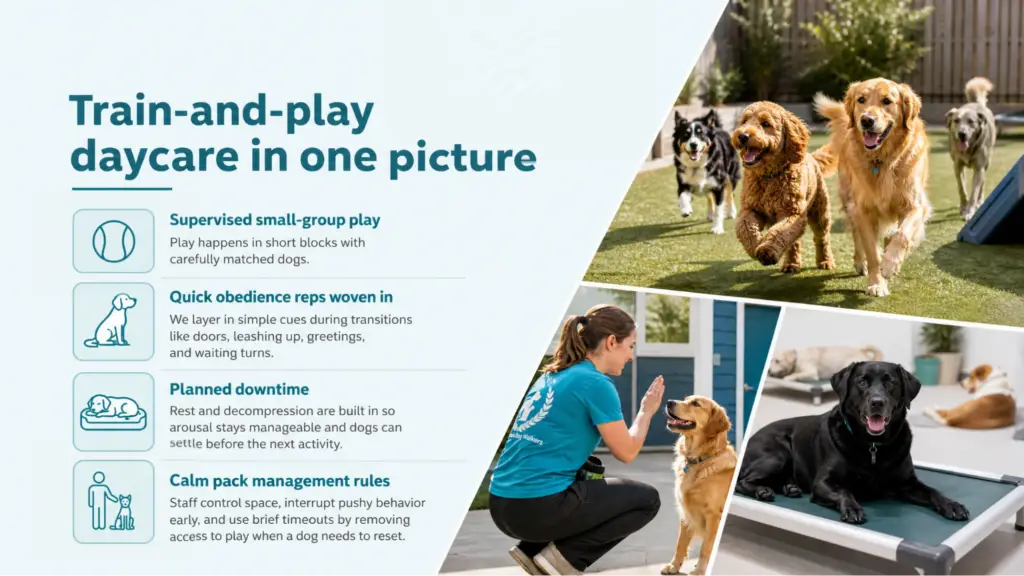
Train-and-play daycare is a structured day where your dog cycles through supervised small-group play, quick obedience reps woven into everyday moments, and planned downtime.
Play happens in short blocks with carefully matched dogs, then we layer in simple cues during transitions like doors, leashing up, greetings, and waiting turns. Rest and decompression are built in so arousal stays manageable and dogs can settle before the next activity.
Calm pack management rules guide the whole room: staff control space, interrupt pushy behavior early, and use brief timeouts by removing access to play when a dog needs to reset.
Train-and-play vs free-play at a glance
If you just want the quick difference, train-and-play is guided, small-group play with built-in obedience reps and rest breaks, while free-play is usually longer open play with fewer structured pauses. Here is what each day typically looks like.
Train-and-play: What your dog’s day looks like
The day is built around planned breaks, guided play, and a clear off-switch so energy does not keep climbing. In a structured day, handlers actively manage play intensity by pairing dogs thoughtfully, interrupting rough or repetitive loops, and rotating groups before anyone tips into unsafe choices. You also get decompression after excitement: calm transitions, water breaks, and downtime that lets breathing and bodies come back to baseline.
That rhythm usually creates safer evening energy at home. Your dog still comes home tired, but the tired looks more like relaxed and cooperative than wired and looking for trouble.
Free-play: What your dog’s day often looks like
In many free-play daycares, dogs can stay in open-ended play longer, which can make it harder for some dogs to come down. Dogs may get plenty of exercise and social time, but there are usually fewer built-in reps and fewer structured practice moments to turn excitement into manners.
That often looks like longer stretches of open play with fewer planned breaks, fewer handler-led interruptions of rough or repetitive loops, and fewer consistent transition reps, like doorways and leash clipping.
This style can be a fine fit for dogs who regulate well on their own, especially if they come home relaxed and can settle after a busy day.
A sample train-and-play day schedule
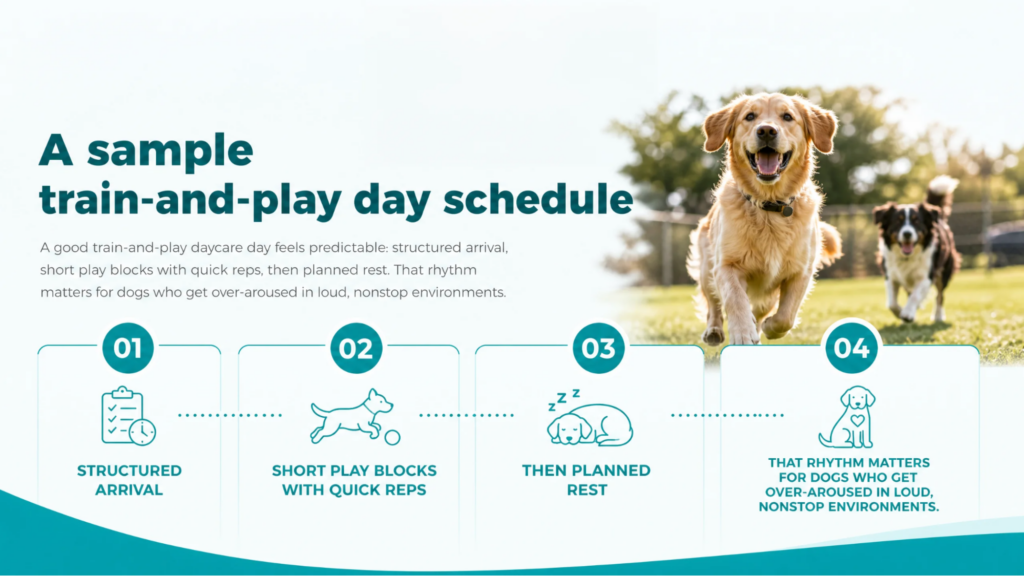
A train-and-play day moves between supervised play, short training sessions, and time to rest. Here’s how that rhythm can look, with activities adjusted to your dog’s comfort and energy level.
A Calm Arrival
We start by matching your dog with a small group that suits their temperament and play style, giving them time to get comfortable before joining in.
Arrival is also a chance to practice everyday manners. We reward calm greetings, polite doorway pauses, and responding to their name. These brief moments help your dog learn to check in with their handler, even when they’re excited to see their friends.
Play With Short Training Breaks
During play, handlers build in pauses to help dogs catch their breath and practice familiar skills before returning to the fun.
Depending on the activity, we might work on:
- Waiting for a toy and letting it go.
- Coming when called.
- Greeting people with paws on the floor.
- Walking politely between spaces.
If jumping or rough play starts, we pause the interaction and help the dog reset. Handlers also adjust groups as needed to keep play styles compatible.
Time to Rest and Recharge
Between activities, dogs unwind in a quiet area or a crate if they’re comfortable using one. Suitable chews or calming enrichment can help them settle.
Handlers watch for signs of discomfort, such as repeated pacing or a tucked posture, and adjust the setup when needed. Dogs return to activities when they’re rested and ready.
If your dog gets overwhelmed at typical daycare, ask how often dogs rest and what happens when one struggles to settle. Those details can tell you a lot about whether the program will suit them.
Safety standards that matter more than marketing
Start with credentials you can verify: a CPR and First Aid certified team, AKC certifications that reflect training skill, plus transparent updates and documentation you can review.
Group size and handler control
Small groups with active supervision keep play from tipping into chaos, especially for dogs who get amped up fast.
Ask how they prevent problems early: handlers should separate dogs before body language turns stiff, match play styles and energy levels, and follow a consistent interruption plan so every dog learns what stops play.
You are looking for a program that can explain, in plain language, how one handler can safely control the whole group in the moment.
- What is your typical group size per handler during play?
- What behaviors trigger a separation before conflict?
- How do you match dogs by play style and energy level?
- What does an interruption look like, step by step?
Clear answers here usually mean your dog gets structure, breaks, and guidance instead of getting swept up in the loudest play.
Time-outs and fair consequences
Time-outs should mean losing access to play for a short reset, then earning a calm return.
In our work, this is simple negative reinforcement: you remove the fun when a dog barrels through cues, then bring it back when they can settle. It lowers arousal levels without intimidation or harsh handling.
The standard to look for is repeatable rules dogs can understand, with the same consequence every time for the same behavior.
Ready for a calmer, more productive daycare day?

If your dog comes home a little too amped from typical daycare, a bit more structure is usually what is missing. In our Train-and-Play Daycare Program, we rotate dogs through supervised small-group play, planned rest and decompression, and light daily training woven into the moments that matter, like doorways, transitions, and greetings.
You still get a dog who is happily tired, plus the kind of day-to-day skills that carry over into walks and home life. We also send a daily report card, so you can see what your dog practiced and how they did.
If you want a daycare day that builds manners and confidence, reach out to schedule an assessment and tell us what you want to focus on, like leash manners, recall, or impulse control.