
Learning how to socialize a puppy on walks starts with short, positive experiences. Give your puppy space to watch people, dogs, and passing traffic, then reward them for staying relaxed. Choose outings that suit their confidence and follow your vet’s guidance as their vaccinations progress.
- Start somewhere quiet. Add busier streets and new distractions gradually.
- Give them room to watch. Your puppy can learn about other dogs without greeting each one.
- Watch for discomfort. Pause or move farther away if your puppy freezes, pulls away, or struggles to settle.
- Plan around vaccination status. Ask your vet which outings are appropriate for your puppy.
At Boston’s Best Dog Walkers, we understand how much trust goes into choosing someone to care for your dog. We offer solo walks, group walks, and dog hiking services to help Boston owners make regular exercise part of their dog’s routine.
If you’re considering professional walks for your puppy, talk with our team about their age, confidence, and experience outdoors so we can discuss a suitable starting point.
Keep reading for a simple walk plan, signs your puppy needs a break, and ways to introduce new experiences while reducing risk.
What Puppy Socialization Means
Puppy socialization helps your dog become comfortable with the people, animals, sounds, and places they will encounter throughout life. The American Veterinary Society of Animal Behavior identifies the first three months as an especially important period for these experiences. Learning continues afterward, so you can keep building on that foundation as your puppy grows.
On walks, that might mean watching a cyclist pass, hearing a delivery truck from across the street, or noticing another dog while you pause on a quiet corner. Give your puppy enough space to explore and observe without feeling pressured to approach.
Look for a relaxed body, interest in their surroundings, and the ability to turn their attention back to you. Some puppies enjoy brief introductions. Others need more time watching from a distance. Let their response guide how much you ask of them.
Signs Your Puppy May Need More Space
Excitement and discomfort can look similar. Watch what happened just before a behavior and how your puppy responds afterward. Several changes together tell you more than one wag, jump, or shake.
- Sudden running or zoomies: A burst of activity after a startling moment can accompany heightened arousal. Notice whether your puppy settles or continues to look tense and avoid the situation.
- Frantic greetings, jumping, or mouthing: If your puppy struggles to pause or turn back toward you, give them a break from the interaction.
- Freezing, pulling away, or a stiff posture: Increase the distance and give your puppy room to move away. A wagging tail alone does not tell you they are comfortable.
- Losing interest in treats or familiar cues: This can be a clue that the surroundings are too distracting or overwhelming. Consider their appetite and the other signals you are seeing.
If several of these signs appear, move to a quieter spot or head home. You can try an easier version of the outing another day. If fear persists or grows, speak with your vet or a qualified reward-based trainer.
Introduce New Experiences While Managing Parvo Risk
Your puppy’s vaccination schedule and early socialization needs overlap. AVSAB supports appropriate socialization before full vaccination in settings where the risk of illness can be minimized. Ask your vet how to plan those experiences based on your puppy’s health, vaccination history, and local disease risk.
Parvovirus can spread through contaminated environments. Cornell University explains that puppies can encounter it even where contamination is not obvious. A sidewalk that looks clean or feels dry should not be treated as proof that it is safe.
Discuss these options with your vet before choosing outings:
- Carry-and-observe outings: Let your puppy watch the neighborhood from your arms or a secure carrier while avoiding contact with public ground.
- Watching from a parked car: Choose a quiet place, keep your puppy securely contained and comfortable, and stay with them throughout the session.
- Time with familiar dogs: Ask about introductions to healthy, vaccinated dogs you know in a private setting your vet considers appropriate.
- A suitable puppy class: Ask your vet about classes with vaccination requirements and cleaning procedures designed for young puppies.
Until your vet advises otherwise, avoid dog parks, shared water bowls, and areas with heavy traffic from unfamiliar dogs. Keep public outings within the limits they recommend.
Early experiences can also happen at home. Introduce visitors gently, explore different household surfaces, and let your puppy hear everyday sounds at a comfortable level. Build variety through small experiences rather than trying to fit everything into one outing.
A Simple Plan for Socializing Your Puppy on Walks
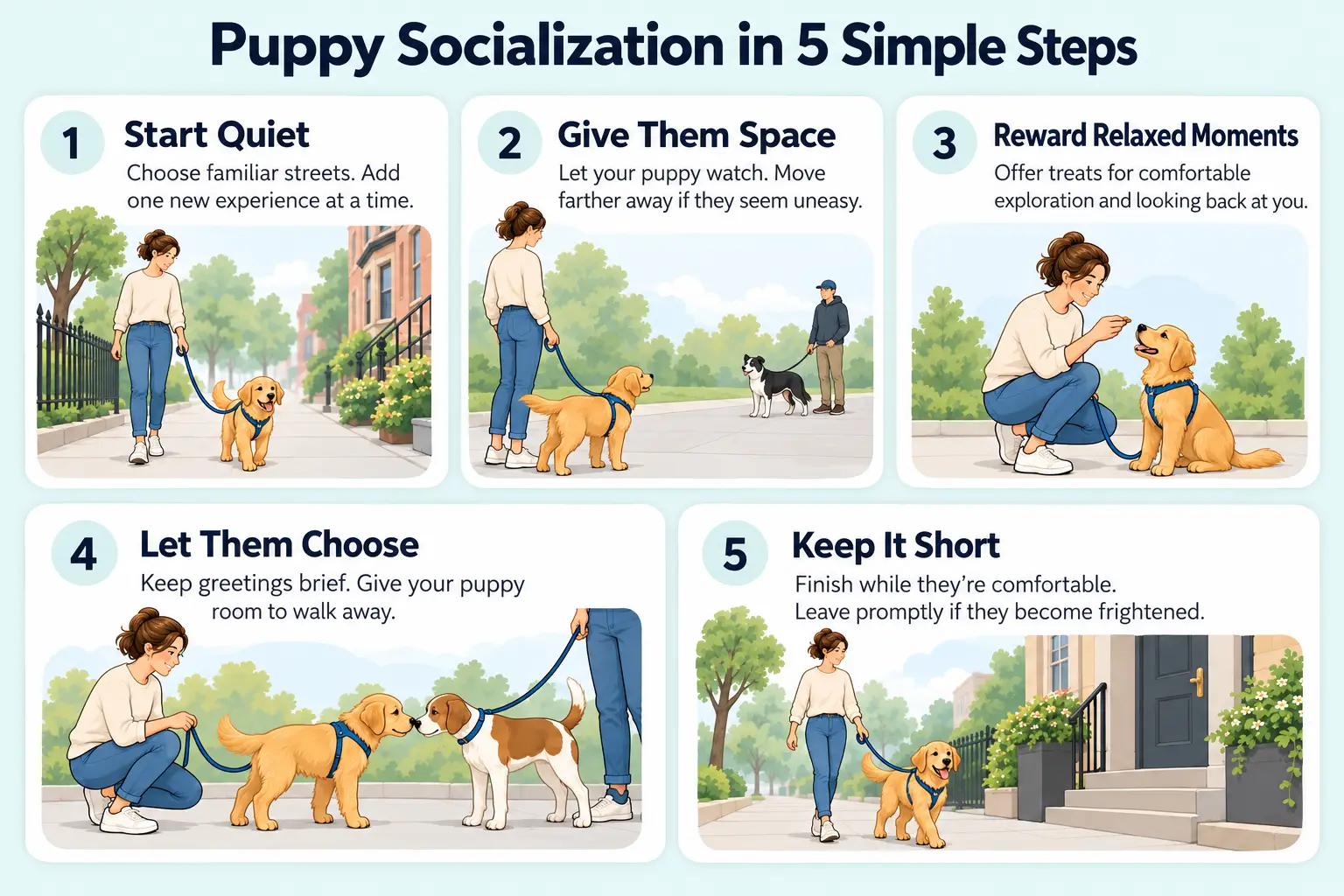
Once your vet has cleared your puppy for walks in the settings you plan to use, start with a short outing close to home. Bring treats your puppy enjoys and choose a route where you can step aside or turn back easily.
Step 1: Choose a Route Your Puppy Can Handle
A quiet street with wide sidewalks gives you room to adjust when a person, dog, or vehicle approaches. Build familiarity there before adding busier surroundings.
Use these route options as a guide:
- Start with a quiet loop: Choose familiar streets with space to move away from distractions.
- Add one new experience: Try a different block or watch a playground from a comfortable distance.
- Visit a busier place at a quiet time: Give your puppy a chance to explore before the crowds arrive.
- Try a brief stretch with more activity: Keep it short and return to the quieter route if your puppy struggles.
Change one thing at a time where possible. A new route, longer walk, and crowded sidewalk all at once can make it difficult to tell what your puppy found challenging.
Step 2: Give Them Space to Observe
When your puppy notices something new, pause at a distance where they can watch without becoming tense. That may be across the street from another dog or well back from a noisy truck.
Allow them to look, sniff, and turn away. If they freeze, try to retreat, or become increasingly agitated, move farther away. There is no set distance that suits every puppy or every situation.
Step 3: Reward Comfortable Exploration and Check-Ins
Offer a treat when your puppy notices a new sight or sound while remaining comfortable. Reward them when they look back at you or follow a familiar cue. These small moments help make outings pleasant and encourage attention to you.
Use the same words and signals you practice at home, but make the task easier outdoors. Try a familiar name response or a few steps beside you in a quiet area before asking for it near distractions.
If your puppy struggles to respond, reduce the distraction or move away. Give them an easier opportunity to succeed rather than waiting beside something that frightens them.
Step 4: Keep Introductions Brief and Optional
Your puppy can learn plenty by watching people and dogs pass. For a direct introduction, choose an appropriate person or familiar dog and leave room for your puppy to approach or move away.
Ask people to let your puppy come to them. Keep any greeting short and pause afterward to see whether your puppy wants more space. If they hide behind you or pull away, let the interaction end.
Step 5: Finish Before Your Puppy Becomes Overwhelmed
Head home while your puppy is still comfortable, even if the outing was shorter than you expected. A brief walk with a manageable new experience gives you something to build on next time.
If they become frightened, leave the situation promptly. You can end the outing without asking for another cue or greeting. Make a note of what was difficult and choose an easier setting for the next walk.
Find Walking Support That Fits Your Dog
Your puppy has a whole world to get to know. Start small, give them time to explore, and build on the experiences they enjoy. A few relaxed minutes on a familiar street can be a great start.
Need a hand fitting walks into your day? Get in touch with Boston’s Best Dog Walkers to find a walking option that suits your dog.