
The Canine Good Citizen (CGC) Test is a 10-skill evaluation that measures how well your dog can handle everyday situations around people, other dogs, and common distractions. Rather than testing tricks or advanced obedience, it focuses on practical manners like polite greetings, loose-leash walking, basic handling, and staying calm when something interesting is happening nearby.
Here are the key things to know:
- The CGC tests 10 everyday manners skills, including greetings, leash walking, handling, recall, and brief separation.
- Your dog does not need advanced obedience skills. The focus is staying calm, responsive, and under control.
- The skills need to hold up around distractions. Doing them reliably at home may not mean your dog is ready for the test.
- You can prepare for the test ahead of time by practicing around unfamiliar people, other dogs, and new environments.
- Urban CGC is designed for busier settings, adding challenges like crowds, traffic, noise, and tighter spaces.
If you are not sure whether your dog is ready, that is where we can help. Boston’s Best Dog Walkers is an AKC-certified training facility offering both Canine Good Citizen and Urban Canine Good Citizen testing and preparation. We work with you and your dog on the skills that need attention and practice them in the kinds of real-life situations Boston dogs encounter every day.
Keep reading for a closer look at what passing the CGC Test actually proves, all 10 skills your dog will be evaluated on, how to check your dog’s readiness, and whether standard or Urban CGC is the better fit.
What The CGC Test Proves
Passing the CGC shows that your dog can stay calm and manageable through everyday interactions with people, other dogs, and common distractions. That includes greeting people politely, accepting brief handling, walking under control, and responding to you even when something interesting is happening nearby.
Those skills matter beyond the test itself. They are the same manners you rely on when passing another dog on the sidewalk, waiting in a lobby, sharing an elevator, or having someone approach your dog.
For renters, a CGC pass can also be a useful way to show a landlord that you have invested in training and that your dog has demonstrated good manners in shared spaces. It does not guarantee a particular housing decision, but it can give you something concrete to point to when discussing your dog’s behavior.
The 10 CGC Skills, Exactly As They Are Evaluated
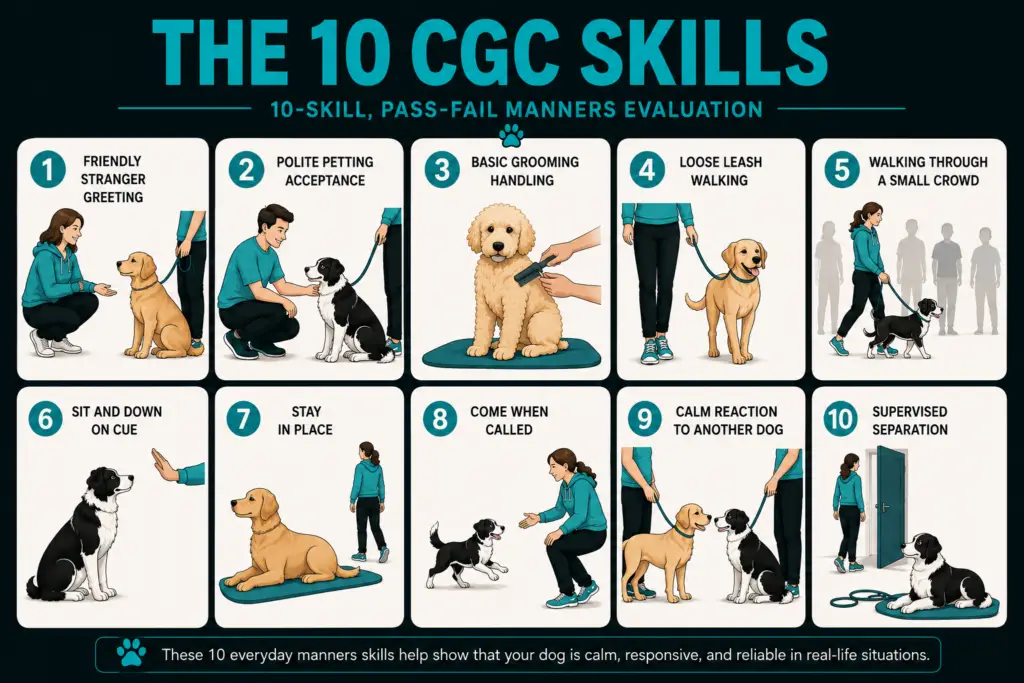
The Canine Good Citizen evaluation measures 10 everyday skills that show how well your dog can stay calm, responsive, and under control around people, other dogs, handling, and common distractions.
Here are the 10 skills that are evaluated:
- Friendly stranger greeting: A stranger approaches, speaks to you, and your dog stays composed with no lunging, hiding, barking fits, or over-the-top jumping.
- Polite petting acceptance: The evaluator pets your dog on the head and body while your dog remains manageable at your side and does not solicit roughly.
- Basic grooming handling: Light handling like ears, paws, and a brief brush or comb; your dog tolerates it without wrestling, snapping, or panicking.
- Loose leash walking: Your leash stays reasonably slack as you change direction and pace; brief tension happens, but pulling is not the pattern.
- Walking through a small crowd: You and your dog move politely around a few people without weaving, forging, or acting worried about close pass-bys.
- Sit and down on cue: Your dog responds promptly to your cue without repeated luring, bargaining, or multiple commands.
- Stay in place: Your dog maintains position while you step away and return, without breaking repeatedly or needing continuous feedback.
- Come when called: With your dog held by another person, you walk away and call; your dog comes directly and can be controlled on arrival.
- Calm reaction to another dog: Two handlers approach with dogs; your dog remains under control and does not try to rush in, posture, or melt down.
- Supervised separation: You leave your dog with the evaluator briefly; your dog may notice you are gone but stays manageable and non-disruptive.
If a few of these skills still feel shaky, that is completely normal. Most dogs need practice in more than one area before they are test-ready. As an AKC-certified training facility, we prepare and evaluate dogs for the CGC right here in Boston, with practice built around the situations they are likely to encounter on test day.
How To Tell If Your Dog Is Ready Before You Pay For A Test
You can get a good sense of readiness before you book the test. Your dog is more likely to be ready when the 10 CGC skills hold up in real places, not just in a quiet room. In our experience, knowing the skill is usually only part of the challenge. The harder part is getting the same response when distractions, excitement, or a new environment are added.
As you practice, look for a few signs:
- Your dog responds without repeated prompting. You should not need to repeat cues, constantly lure your dog, or spend several minutes warming up before a skill works.
- The skill holds up around distractions. Start somewhere quiet, then gradually add people, other dogs, greetings, traffic, or city noise.
- Greetings stay under control. A dog that sits nicely at home may jump when an unfamiliar person approaches. Practice with different people so four paws stay on the floor through the greeting and brief handling.
- The leash stays reasonably loose. Your dog does not need a competition-style heel, but they should be able to pass smells, people, and other dogs without constantly pulling toward them.
- Your dog can handle brief separation. Have someone hold the leash while you step away. It is okay if your dog notices you are gone, but they should remain manageable without nonstop barking, spinning, or hard pulling.
- Your dog can recover from excitement. Getting distracted is not unusual. What matters is whether your dog can settle and respond to you again without a major struggle.
If you are not sure whether these skills are ready for test day, our Canine Good Citizen Test Program can help you see what is already solid and where your dog could use more practice.
CGC vs. Urban CGC: Which Is Right For Your Dog?
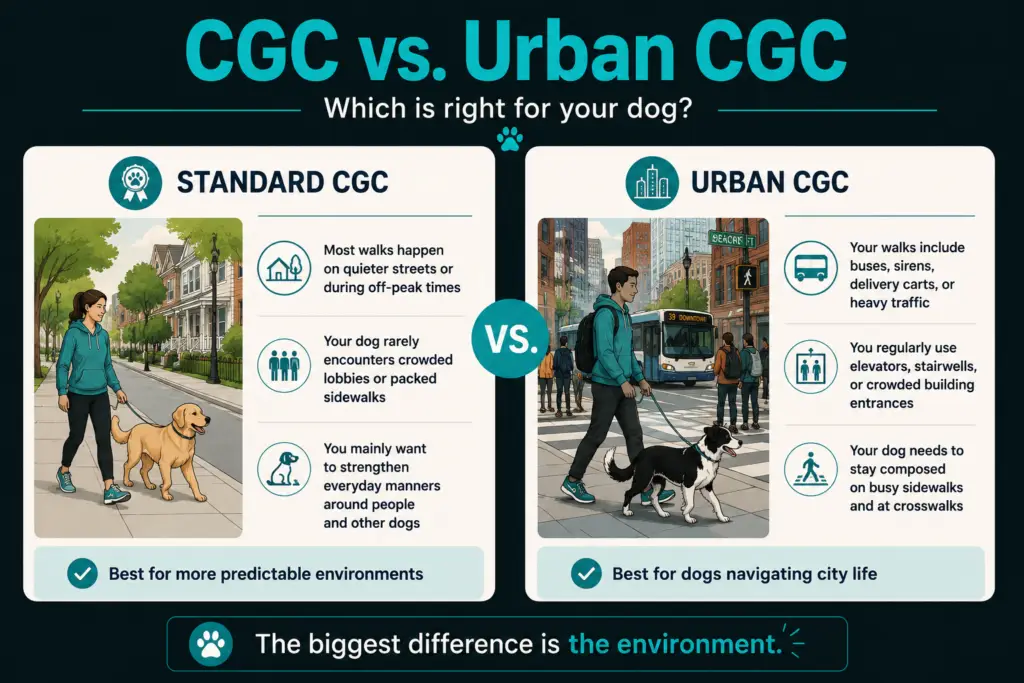
Standard CGC may be the better fit if your dog’s day-to-day environment is fairly predictable. Think quieter neighborhoods, familiar walking routes, and situations where distractions can usually be introduced gradually.
- Most walks happen on quieter streets or during off-peak times
- Your dog rarely encounters crowded lobbies or packed sidewalks
- You mainly want to strengthen everyday manners around people and other dogs
Urban CGC may make more sense if your dog regularly navigates busy Boston environments. It tests those same good-manners skills in situations where noise, crowds, traffic, and tight spaces make staying calm more challenging.
- Your walks include buses, sirens, delivery carts, or heavy traffic
- You regularly use elevators, stairwells, or crowded building entrances
- Your dog needs to stay composed on busy sidewalks and at crosswalks
For many Boston dogs, the difference comes down to the environment. If your dog already handles everyday manners well but struggles when the city gets busy, Urban CGC gives you a more realistic goal to work toward.
Ready To Work Toward Your CGC?

You don’t need to figure out test prep on your own. We help Boston dog owners practice the skills their dogs need in the real environments where they will actually use them, from everyday greetings and leash walking to busy sidewalks and city distractions.
Explore our dog training programs and get your dog ready for test day.
Frequently Asked Questions
Is The CGC Test Hard To Pass?
It is very doable when your dog can repeat the 10 skills calmly with realistic distractions. Most dogs struggle when excitement or nerves show up, so your prep should include practice around strangers, other dogs, and busy environments.
How Much Does A CGC Test Cost?
The test fee depends on the evaluator and the specific testing event, so there is no single set price. We recommend confirming the fee when you schedule and focusing first on readiness so you are not paying to re-test.